AI 101
AI agent
Also called: AI agents, agentic AI
An AI agent works toward a goal by choosing steps, using available tools, checking what happened, and continuing until the task is finished or it needs a person.
Why it matters
A normal chatbot mainly answers the request in front of it. An agent may be allowed to do parts of the job, such as checking files, gathering information, or updating a workspace.
Example
You could ask an agent to organize a folder of receipts, flag anything unclear, and prepare a review list instead of explaining the sorting process one file at a time.
What to watch for
More independence also means more ways to make a consequential mistake. Start with work you can review and undo, and require approval before sending, buying, deleting, or publishing.
AI 101
AI automation
Also called: AI workflow, automated AI workflow
AI automation adds an AI step to a repeatable process with a clear trigger and destination: when this happens, have AI do this limited job, then save or send the result here.
Why it matters
You often do not need an autonomous agent. A predictable automation is easier to test when the same small task keeps coming back.
Example
When a client inquiry arrives, an automation can summarize the request, pull out the deadline, and save a draft reply for you to approve.
What to watch for
Do not let a simple workflow quietly become an unsupervised sending system. Keep approval steps around messages, money, private data, and irreversible actions.
AI 101
AI API
Also called: API, AI application programming interface, API key
An AI API is the connection software uses to send a request to an AI model and receive a result without a person opening the consumer chat app for every request.
Why it matters
APIs are how forms, websites, automations, and other products can use AI behind the scenes. An API key authorizes the connection and may tie its usage to your account.
Example
A support form can send a customer question through an API, receive a draft response, and place that draft in an inbox for review.
What to watch for
Treat an API key like a password. Never show a real key on screen, place it in public code, or paste it into a service you have not checked.
AI 101
AI hallucination
Also called: hallucination, hallucinated answer
An AI hallucination is a believable-looking answer that is false, unsupported, or invented.
Why it matters
Fluent writing can feel like proof even when the model has produced a fake citation, wrong date, nonexistent feature, or confident explanation with no evidence.
Example
If an AI names a research paper, ask for the direct source and confirm that the title, authors, and claim actually appear there.
What to watch for
Asking the model to be accurate is not verification. Check important claims against reliable sources, especially for health, legal, financial, safety, and current-product information.
AI 101
AI skill
Also called: AI skills, Claude skill, saved AI playbook
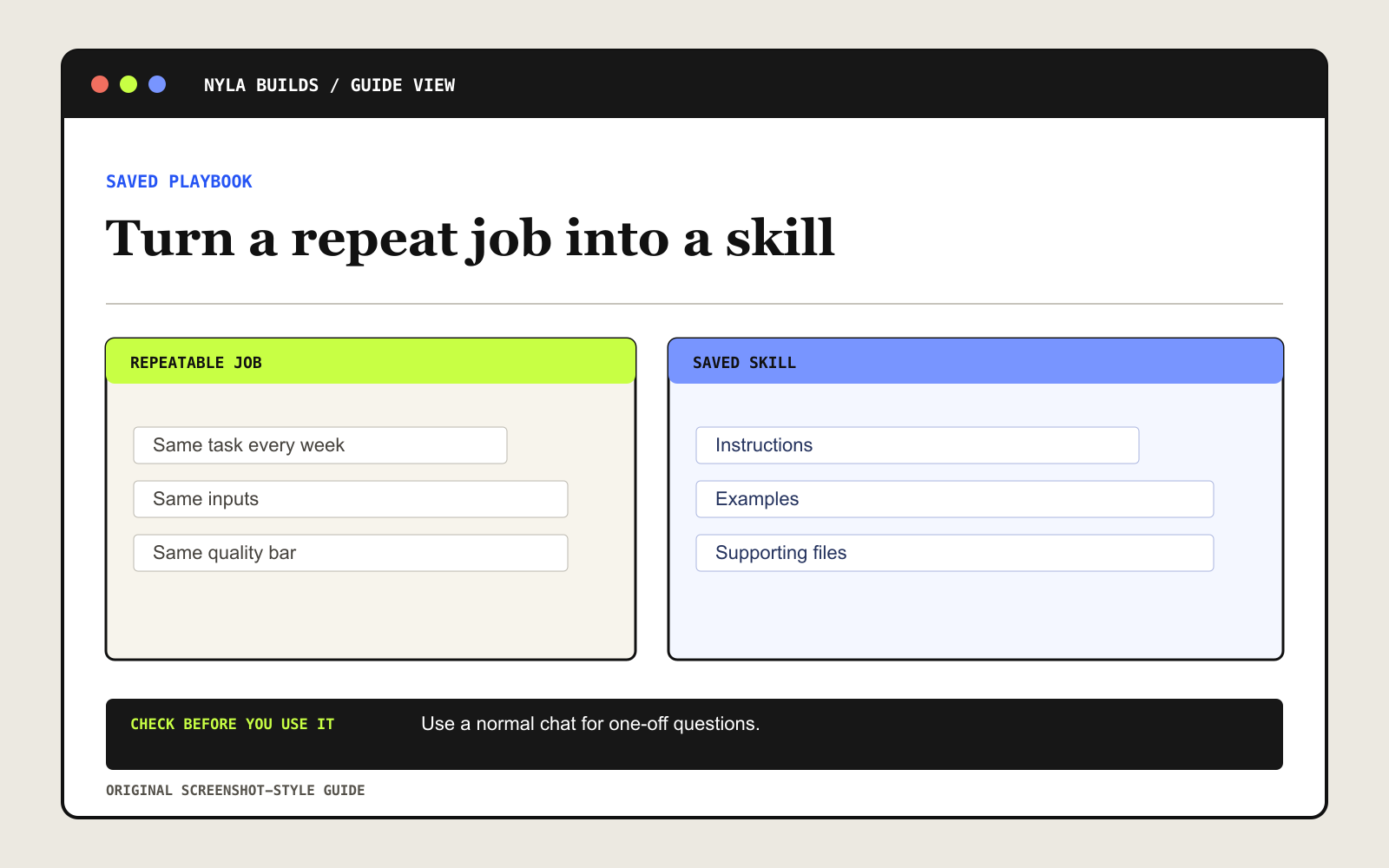
An AI skill is a reusable playbook containing instructions, examples, and supporting material for one job you do repeatedly.
Why it matters
A good skill keeps you from rebuilding the same setup every time. It can hold the format, checks, examples, and files an AI should use for that task.
Example
A creator could make a skill that turns messy client briefs into the same reviewable Reel outline each week.
What to watch for
A skill does not repair weak instructions by itself, and every AI product implements reusable skills differently. Review the output and improve the playbook when it misses.
AI 101
AI tokens
Also called: tokens, token count
Tokens are the small units an AI model processes when it reads input and generates output. They are not a one-to-one word count.
Why it matters
Your prompt, earlier messages, files, images, tool results, and the answer being generated can all use tokens and share the available context space.
Example
A long conversation with several uploaded files can use far more tokens than the visible final question suggests.
What to watch for
A token count is not a universal score for intelligence or answer quality. Products and models count and expose usage differently.
AI 101
Computer use
Also called: computer-use model, AI computer use
Computer use is the ability for an AI system to interpret a screen and interact with software through actions such as clicking and typing.
Why it matters
Instead of only telling you which buttons to press, a supported agent may be able to move through part of the task itself.
Example
You can have a computer-use agent test a form on a staging website and report where the process becomes confusing.
What to watch for
Begin with low-stakes work. Take over around logins, payments, public posts, private information, or any action that is hard to reverse.
AI 101
Context window
Also called: AI context window, context limit
A context window is the working space an AI model can use for the current request, including instructions, conversation history, files, tool results, and room for its response.
Why it matters
Long chats can become crowded. Older details may be summarized, receive less attention, or fall outside what the model is using.
Example
When a project thread starts losing important details, begin a fresh chat with a short brief and only the files needed for the next step.
What to watch for
A larger context window does not guarantee that every detail will be used correctly. Keep the relevant information organized and repeat critical constraints when necessary.
AI 101
Custom GPT
Also called: custom GPTs, GPT in ChatGPT
A custom GPT is a configured version of ChatGPT made for a particular purpose using instructions, optional knowledge files, and selected capabilities.
Why it matters
It can turn a prompt you repeatedly rebuild into a named assistant you reopen for the same type of work.
Example
You could configure a GPT to turn rough content ideas into a fixed outline and always ask for missing audience or source details first.
What to watch for
Access and creation controls can depend on the current ChatGPT plan and workspace. Review what files and actions the GPT can use before sharing it.
AI 101
Generative AI
Also called: gen AI, GenAI
Generative AI creates new content such as text, images, audio, video, or code from patterns learned during training and the instructions or material you provide.
Why it matters
It describes a capability, not one company or app. Chat tools, image generators, music tools, coding assistants, and video products can all use generative AI.
Example
When an AI drafts an email, produces an illustration, or creates the first version of a short video, it is generating content.
What to watch for
Generated does not mean accurate, original, or ready to publish. You still need to check facts, permissions, taste, and fit.
AI 101
MCP
Also called: Model Context Protocol, MCP server
MCP stands for Model Context Protocol. It is an open standard for connecting AI applications to outside tools and information through a consistent interface.
Why it matters
Think of it as an adapter: an AI application can use an approved connection to retrieve context or perform an allowed action instead of relying on manual copy and paste.
Example
An MCP connection might let an AI application read selected calendar events or search a project database when answering your question.
What to watch for
The connection can expose real data or actions. Check what a server can read, write, or send before installing it, and do not treat a popular setup video as a security review.
AI 101
Multimodal AI
Also called: multimodal model, multimodality
Multimodal AI can work with more than one kind of information, such as text, images, audio, video, or files, when the specific product supports those inputs or outputs.
Why it matters
You do not always have to describe a visual or audio problem in a long typed prompt. Giving the model the original material can provide clearer context.
Example
Upload a screenshot of an error and ask what it sees, or provide a voice note and ask for the decisions and next actions.
What to watch for
Supported formats, size limits, privacy rules, and quality differ by product. Remove private details and confirm the tool supports the material before uploading it.
AI 101
OpenClaw
Also called: Open Claw, Clawdbot, Moltbot
OpenClaw is an open-source personal AI assistant that runs through a gateway you control and can connect AI models to tools, files, accounts, and messaging channels.
Why it matters
People use it to keep one assistant available across the apps and devices they already use, with the ability to do more than answer a question in chat.
Example
You could connect OpenClaw to a private messaging channel and ask it to summarize a document from an approved folder, then return the result in that chat.
What to watch for
A local setup is not automatically safe. The gateway and connected tools can act with your authority, so limit access, keep it private, use strong authentication, review plugins, and never expose a trusted gateway as a public service.
AI 101
Vibe coding
Also called: AI coding by prompting, natural-language coding
Vibe coding is the informal practice of describing what software should do in natural language and letting an AI tool generate much of the code or first working version.
Why it matters
It can make small prototypes more approachable for people who do not manually write every line of code.
Example
You might ask an AI coding tool to create a simple study planner, preview it, then keep describing changes while testing each button.
What to watch for
A convincing preview is not proof that an app is secure or reliable. Test the behavior and avoid treating an unreviewed prototype as production software for money, health, payroll, or private data.
Sources & verification22
- OpenAI — A practical guide to building AI agents ↗
- Anthropic — Trustworthy agents in practice ↗
- IBM — AI workflow ↗
- IBM — Agentic automation ↗
- OpenAI — Developer quickstart ↗
- OpenAI — API authentication ↗
- OpenAI — Why language models hallucinate ↗
- Anthropic — The complete guide to building skills for Claude ↗
- OpenAI — Token counting ↗
- Anthropic — Context windows ↗
- OpenAI — ChatGPT release notes: computer use ↗
- OpenAI — Computer use model ↗
- OpenAI — GPTs in ChatGPT ↗
- OpenAI — Creating a GPT ↗
- NIST — What is generative AI? ↗
- Model Context Protocol — Introduction ↗
- Model Context Protocol — Security best practices ↗
- Google AI — Multimodal file prompting ↗
- Merriam-Webster — Vibe coding ↗
- OpenClaw — Getting started ↗
- OpenClaw — Tools overview ↗
- OpenClaw — Gateway security ↗