Step 1 · ChatGPT Work
Start with the jobs you actually want
ChatGPT Work is designed for longer tasks that research and organize information while you can follow its progress. Ask it to work from public sources, keep the original listing link attached to every result, and stop when a listing cannot be verified.
Work availability and the ability to create files can vary by plan, connected apps, and rollout status. If you do not see Work, run the same prompt in ChatGPT with Deep Research and ask for a copy-ready brief and tracker instead.
A request such as "find me a good job" leaves too much room for generic results. Include the role, location or remote preference, salary floor, experience level, and anything that would make you reject a listing immediately.
Find current [ROLE] jobs in [LOCATION OR REMOTE]. My salary floor is [AMOUNT], I have [EXPERIENCE LEVEL], and my dealbreakers are [LIST]. Return the original posting link, salary when listed, posting date when available, and why each role may fit. Flag anything you cannot verify, and do not invent missing details.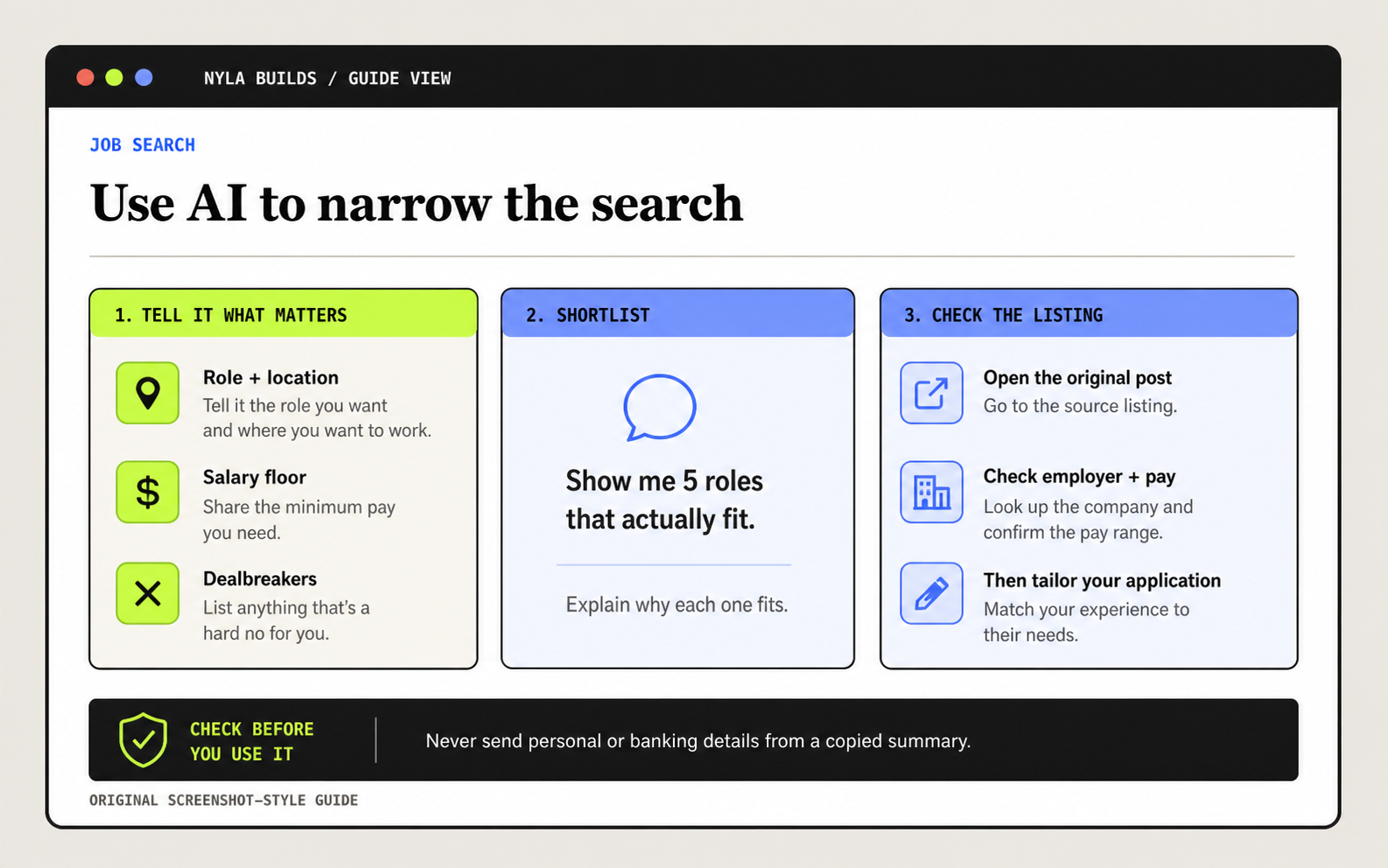
Before you apply
A search result is a lead, not the job
The best part of an AI job search is narrowing the field. The risky part is treating the summary like the listing. Open the original posting, check that it still exists, and only then spend time tailoring your application.
- Open the original posting instead of applying from a copied summary.
- Confirm that the listing is still active and appears on the employer or trusted job platform.
- Check the employer name, location, salary, requirements, and application destination yourself.
- Do not send identity documents, banking details, or payment to someone simply because a result appeared in ChatGPT.
Copy this into ChatGPT Work
Give ChatGPT one research job instead of opening listings one by one
This prompt starts with an interview, then turns your answers into a short job-search brief and a tracker. It is built for research and organization. It does not apply, contact employers, create accounts, or make decisions for you.
Ask for a document and spreadsheet only when your version of Work can create them. Otherwise, the same prompt asks for copy-ready text and CSV so you can keep the result anywhere you like.
- Answer the interview questions with the limits that genuinely affect your search.
- Review the profile summary before the research starts and correct anything that is wrong.
- Open the original listing before you tailor an application or share personal information.
You are my Remote Job Search Map.

Help me research and organize a realistic remote job search. Do not apply to jobs, contact anyone, submit forms, create accounts, or use private information beyond what I explicitly provide. Use public sources only. Do not invent job listings, salaries, company policies, benefits, locations, application requirements, or posting dates.

First, ask all interview questions in one grouped questionnaire, then wait for my answer before researching. Ask about: my work history and responsibilities; the work and seniority level I want next; salary minimum and currency; location, time-zone, work-authorization, and employment restrictions; industries and work cultures I would consider or avoid; skills, tools, certifications, languages, and proof of work; preferred employment type; weekly capacity for applications and outreach; and whether I want editable files, connected-workspace files, or copy-ready text and CSV. Do not ask for my full address, date of birth, government ID, Social Security number, passport details, or login credentials.

After I answer, summarize my target profile and wait for my confirmation before researching. Then create a Remote Job Search Brief with: 5 to 10 roles that genuinely fit; why each fits; 10 companies, official career pages, job boards, or talent networks to monitor; constraints to watch for; the top 3 skill or proof gaps to strengthen; a realistic two-week search plan; and assumptions I should verify myself.

Then research 10 to 20 current public opportunities that fit my criteria. Prioritize roles posted within the last 30 days. Include an older listing only when the original source clearly shows it is still active. Exclude expired, duplicate, unavailable, scraped-without-original-source, and materially incompatible listings. If fewer than 10 qualify, say so instead of relaxing my criteria.

For every opportunity include: company, role, direct original URL, source website, posted date when available, remote location rules, salary only when explicitly listed, one-sentence fit note, requirements to verify, date found, and a specific next action. Label uncertain details Verify. Do not infer missing facts or recommend applying to an incompatible role.

Create two editable outputs when supported: a document named Remote Job Search Brief - [my target role], and a spreadsheet named Remote Job Tracker - [my target role]. The tracker needs these columns: Company | Role | Direct Link | Source | Posted Date | Remote Location Rules | Salary Listed | Why It Fits | Requirement To Verify | Status | Next Action | Date Found. Set every new Status to To Review. If editable files are unavailable, return the brief in copy-ready document format and the tracker as a Markdown table plus CSV. End with the three highest-leverage actions I should take this week.
Step 2 · Claude
Use six Claude prompts to move from match to interview
Start with one real job description and your current resume. The six prompts below move from “do I actually match this?” to “can I explain my experience out loud?” without asking Claude to invent experience you do not have.
Remove your address, phone number, references, identification numbers, and any other private information before uploading files. Copy the prompts one at a time so you can review each result before moving on.
Prompt 1
Check how your resume matches the role
Compare my resume with this job description for [ROLE]. Return three sections: strong matches already supported by my resume, important requirements my resume does not show, and the three truthful edits that would improve the match most. Flag vague bullets and relevant keywords I may have missed, but do not invent skills, experience, credentials, or metrics.

Resume: [PASTE]

Job description: [PASTE]
What a believable answer looks like
Example input: the listing says, "Own the weekly email calendar and report on open rates." Your resume says, "Sent weekly customer emails and tracked campaign results."
A believable response should call that a supported match, point out what evidence is still missing, and suggest a truthful edit such as naming the reporting tool or result only if it appears in your original resume. It should not manufacture a percentage because the bullet sounds stronger with one.
Prompt 2
Tailor the resume
Rewrite my resume for this [ROLE] position. Return three sections: revised bullets, what moved higher and why, and claims I still need to verify. Prioritize the experience that genuinely matches the job description, move the strongest proof higher, and make each bullet clear and specific. Keep the language natural and easy for an applicant tracking system to read. Do not add any skill, responsibility, result, or number that is not supported by my original resume. Review every bullet against the original before I use it.

Resume: [PASTE]

Job description: [PASTE]
Prompt 3
Draft a human cover letter
Using my resume, this job description, and the two short writing samples below, return two labeled sections: a cover letter under 200 words and claims to verify before sending. Open with the company’s current need and why my real experience may help. Use my natural voice, avoid clichés, and do not make unsupported claims. Review every sentence against the resume and job description.

Resume: [PASTE]

Job description: [PASTE]

Writing samples: [PASTE TWO SHORT SAMPLES]
Prompt 4
Make LinkedIn easier to understand
Rewrite my LinkedIn profile for remote [FIELD] roles. Return exactly three labeled sections: headline options, revised About section, and search terms to keep only if they match my background. Make the work I do, the problems I solve, and the experience I can prove clear within the first few lines. Keep it specific, warm, and human. Flag any phrase that needs evidence before I publish it.

Current profile: [PASTE]

Target roles: [PASTE]
Prompt 5
Research a realistic salary range
Help me research the current salary range for [ROLE] at [COMPANY] in [LOCATION OR REMOTE]. Return exactly four labeled sections: sources and evidence, likely range, factors that could move the offer, and a short negotiation script. Use reliable, current sources and link each one. Flag conflicting or missing data. Do not invent a salary range when the evidence is weak. Review the evidence before I use the number.Prompt 6
Practice the interview
Using my resume and this job description, return exactly two sections: 10 likely interview questions with a simple answer framework for each, and three thoughtful questions to ask the interviewer about the role, team, and expectations. Base every framework only on experience shown in my resume. Mark any answer that needs a real example from me before I practice it. Do not invent achievements, numbers, or experience.

Resume: [PASTE]

Job description: [PASTE]
Optional practice loop
Make Claude interview you one question at a time
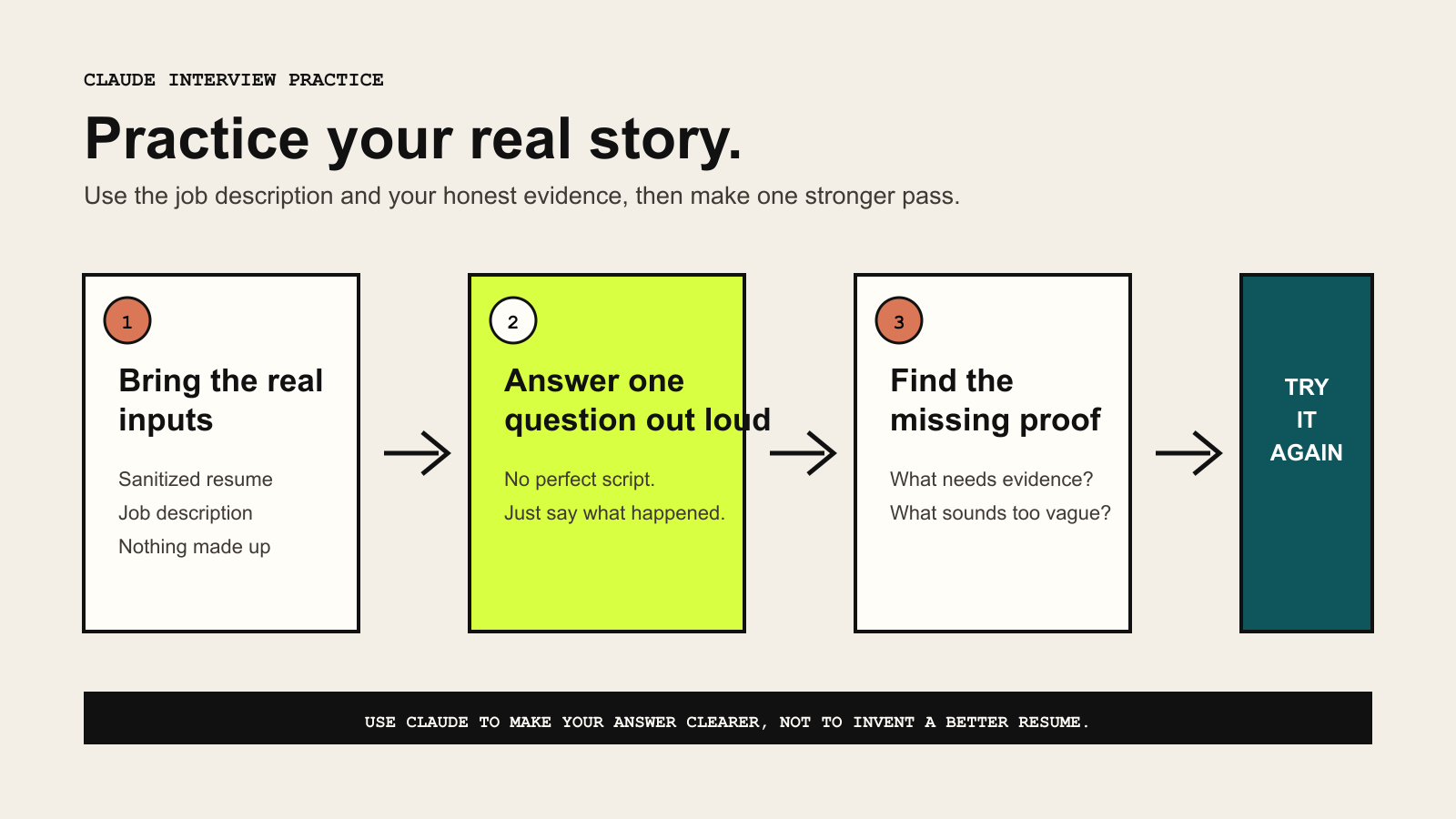
Use this after the six prompts when you want to practice speaking, not just polish a document. Answer out loud first. Claude's job is to find the missing evidence and ask a useful follow-up, not to invent a better candidate.
Use my sanitized resume and the job description below to conduct a realistic practice interview for this role. Return each turn in this order: one question, my answer, the claim needing stronger evidence, one vague phrase to improve, one useful follow-up, and a second answer in my own words. Ask one question at a time and wait for my answer.

Do not invent achievements, employers, numbers, or experience. If information is missing, ask me for it. Do not claim to know the company's private interview process. At the end, return the three areas I should practice again.

Job description: [PASTE]

Sanitized resume: [PASTE]
Final check
Keep the application true and reviewable
ChatGPT and Claude can save you time, but neither can promise that a listing is current, real, or right for you. They also cannot promise an interview. Check the original listing, confirm every claim in your application, and make sure the final wording still sounds like you.
- Open the employer's original posting one more time.
- Read every resume and cover-letter claim against the source resume.
- Remove polished language you would never say in an interview.
- Keep one concrete example ready for each major requirement.
- Ask two or three real questions about the role, team, and expectations.