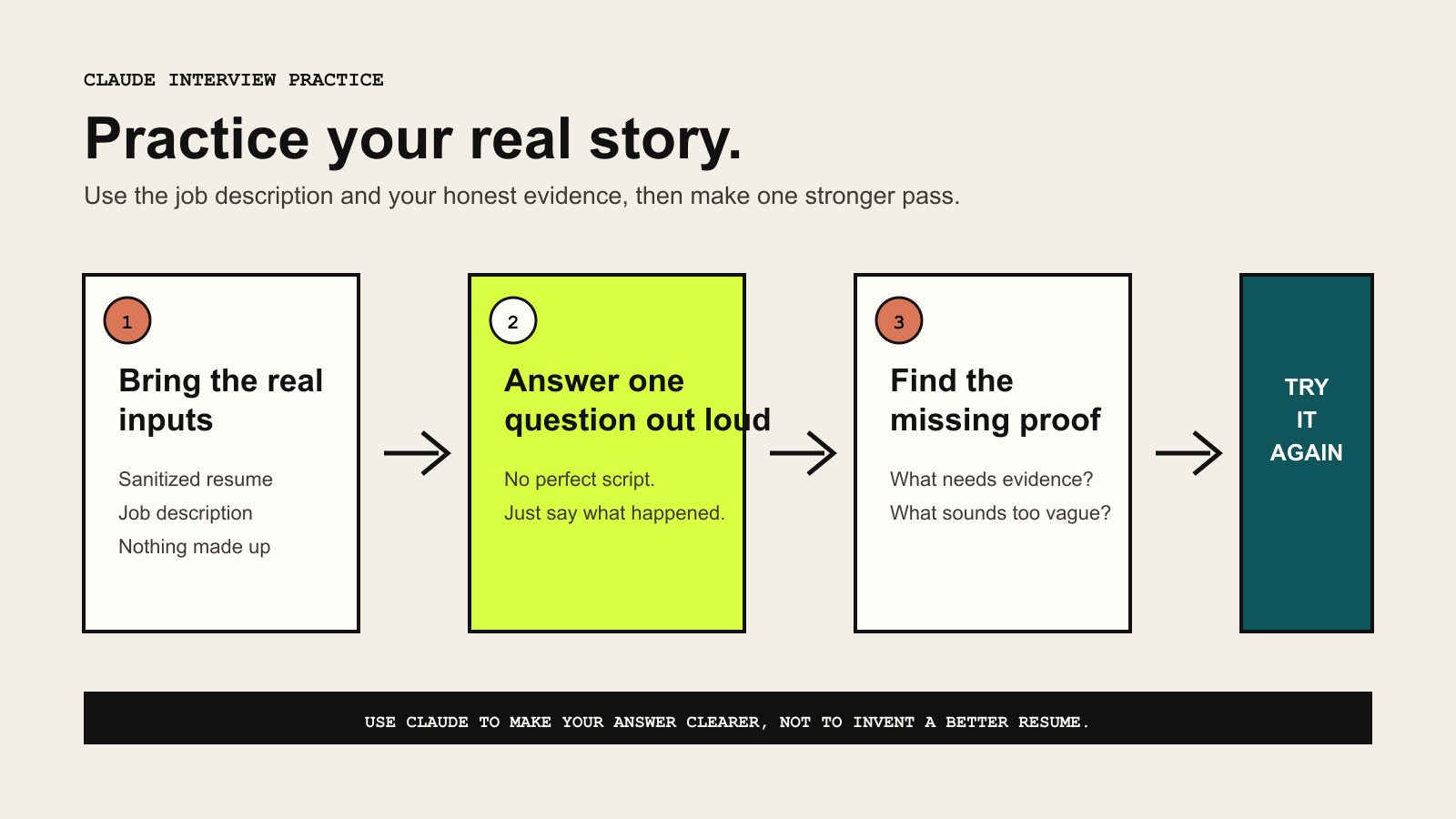
Use the real role and remove personal details first
Start with the job description and a current resume. Remove your address, phone number, email, references, identification numbers, and anything else Claude does not need for the practice session.
Keep the experience, skills, dates, and results that the interviewer may ask you to explain. The point is to practice your real evidence, not generate a more impressive fictional candidate.
Run the interview one question at a time
Use my sanitized resume and the job description below to conduct a realistic practice interview for this role. Ask one question at a time and wait for my answer.

After each answer:
1. Tell me which claim needs stronger evidence.
2. Point out vague or overly general language.
3. Ask the most useful follow-up question.
4. Let me answer the original question again.

Do not invent achievements, employers, numbers, or experience. If information is missing, ask me for it. Do not claim to know the company's private interview process. At the end, summarize the three areas I should practice again.

Job description: [PASTE]

Sanitized resume: [PASTE]
Answer out loud, then make one stronger pass
- Read the question once and answer aloud without polishing every sentence.
- Check whether your answer names the situation, what you did, and what changed.
- Use Claude's follow-up to find the missing evidence, not to replace your story.
- Answer the original question again in your own words.
- Save the three weak areas from the final summary and practice those again tomorrow.
A specific setup gives you more useful questions
For example, a vague request such as “help me prepare for marketing interviews” can produce generic questions. A real growth-marketing job description plus your sanitized resume gives Claude the role's channels, seniority, responsibilities, and the evidence you can honestly discuss.
Claude still cannot know the hiring manager's private question list or guarantee which topics will appear. Use the session to make your examples clearer and more specific.
Keep the final answers true and speakable
- Remove any sentence that adds an achievement or number you cannot prove.
- Replace polished phrases you would never say with your normal wording.
- Keep one concrete example ready for each major requirement in the job description.
- Prepare two or three real questions about the role, team, and expectations.