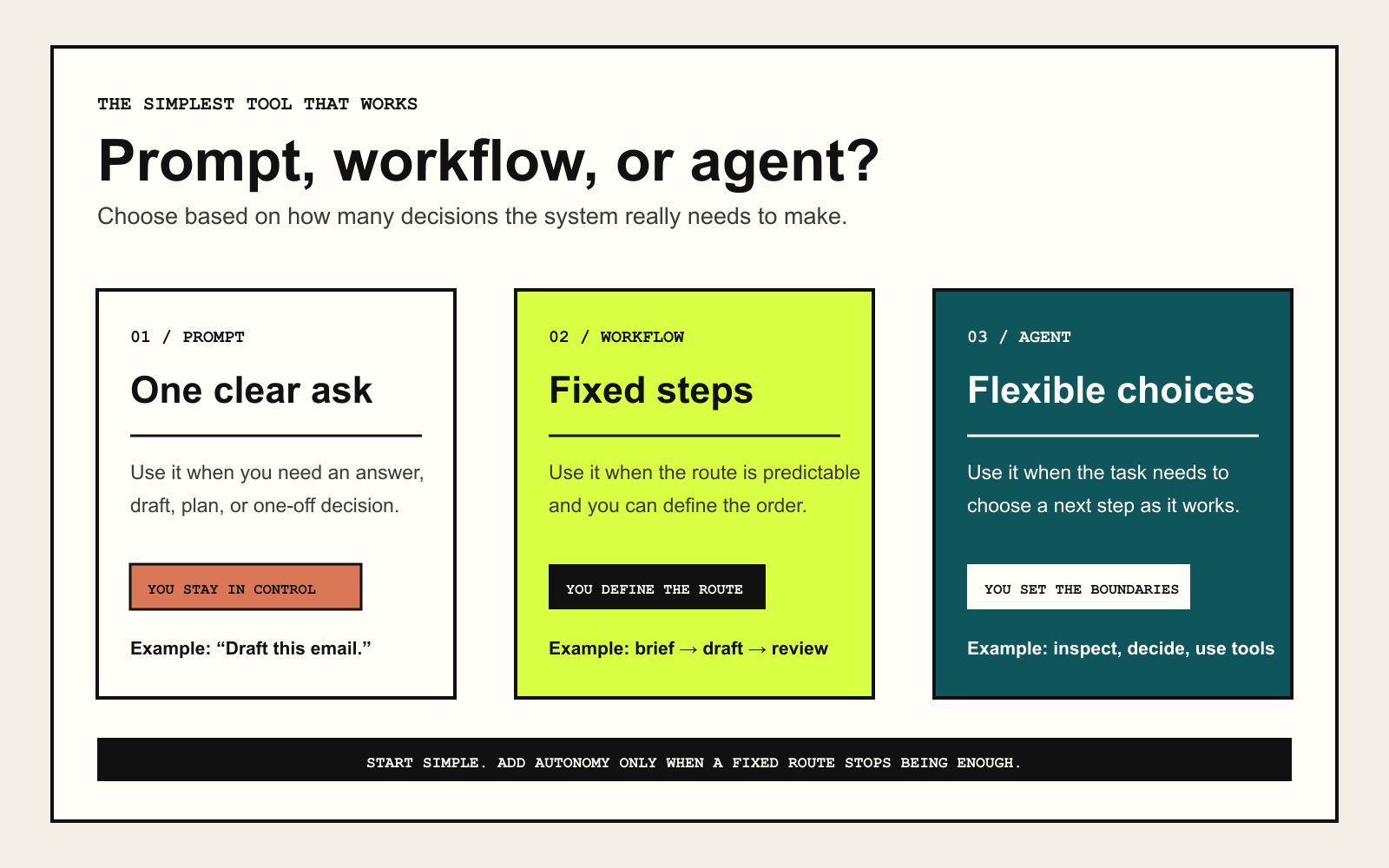
Ask how much freedom the job really needs
A workflow follows steps you define in advance. An agent can inspect what happened, choose the next action, use tools, and adjust while it works.
Use a workflow when the route is predictable. Consider an agent when the task is open-ended and the system genuinely needs to make flexible decisions. More autonomy can also mean more cost, slower runs, and more ways for small errors to compound.
Learn the difference before collecting tools
The first resource gives you the map. The second teaches the patterns in depth. The third is where you look when you are ready to inspect working code.
- 1. Anthropic - Building Effective Agents
Start here for the clearest explanation of workflows, agents, common patterns, tradeoffs, and human checkpoints.
- 2. DeepLearning.AI - Agentic AI
Use this when you are ready for an intermediate course built around Python, tool use, planning, reflection, and evaluation. Course videos can be audited free; graded work and certificates require Pro as of July 26, 2026.
- 3. Anthropic - Claude Cookbooks
Use the notebooks as technical reference code once you know which pattern you are trying to build.
Ask for the simplest setup that can do the job
Help me decide whether this task needs a normal prompt, a fixed workflow, or an AI agent.

Task: [DESCRIBE THE JOB]
Inputs available: [FILES, DATA, OR TOOLS]
Decisions the system may need to make: [LIST]
Actions it may take: [LIST]
What could go wrong: [LIST]
What a successful result looks like: [DEFINE IT]

Recommend the simplest option that can reliably complete the task. Explain why. If you recommend a workflow or agent, map the steps, tool permissions, stopping condition, human checkpoints, and one small test I can run before connecting real accounts or data.
Prove one loop before you build the whole system
- Choose one low-risk task with a result you can check.
- Write the fixed steps first and mark the one place where a flexible decision may help.
- Give the system only the tools and data that test needs.
- Set a maximum number of attempts and a human approval point before any consequential action.
- Compare the result with the simpler workflow. Keep the agent only if the added flexibility produces a real improvement.
An agent still needs your boundaries
Do not begin with live payments, public posting, customer records, or broad account access. Test in a sandbox or on reversible work, log what the system does, and require approval before actions that affect people, money, private data, or production systems.
The question is not whether an agent sounds advanced. It is whether it completes this specific job more reliably than the simpler option.